
 Sambhavi Gautam
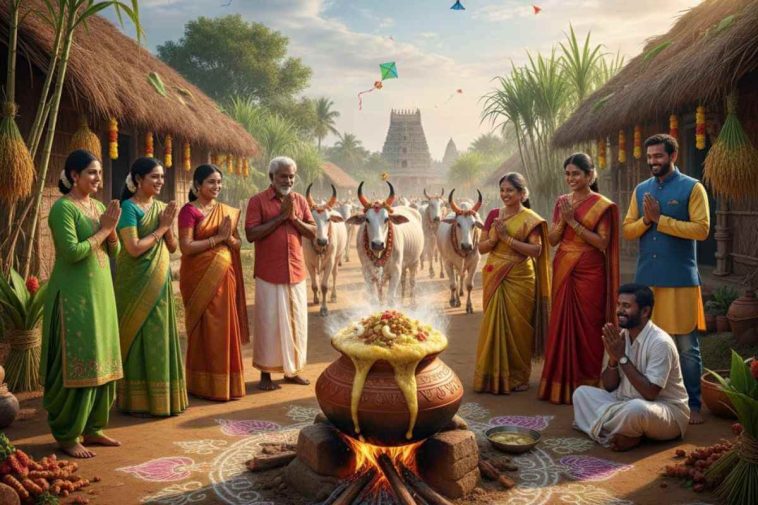
India’s harvest festivals are among its oldest living traditions, rooted in land, labour, and gratitude. While the world often recognises India through mainstream celebrations, festivals like Makarsankranti, Bhogi, Surya Pongal, Mattu Pongal, and Kaanum Pongal remain deeply regional and quietly powerful. In an era shaped by Make in India initiatives and renewed pride in Indian culture, understanding these festivals becomes a way of celebrating India from its roots. They honour farmers, cattle, seasons, and community and remind us that Indian culture has always been sustainable, cyclical, and deeply local long before it became a global conversation.
Also Read: Kites Paint Skies Across India as Makar Sankranti 2026 Ushers in Seasonal Change
India’s Oldest Living Traditions
The beauty of India lies in this diversity, where the same harvest is celebrated differently across regions, languages, and customs but is bounded by shared gratitude. So, let me take you on this journey of unfolding the harvest festivals state by state.
Where Fire, Food, and Community Mark the Harvest
Starting from the north, In Punjab and Haryana, the harvest season is marked by Lohri, celebrated around mid-January, coinciding with Bhogi and the broader Makar Sankranti cycle. Lohri traditionally marks the end of winter and the rabi crop harvest, especially sugarcane and wheat. Bonfires are lit in village courtyards and community spaces, symbolising renewal and the letting go of the old. Families gather to sing folk songs, perform bhangra and giddha, and offer rewri, gajak, peanuts, sesame seeds, and sugarcane to the fire as expressions of gratitude.
In Haryana, Lohri is also closely tied to agricultural prosperity and is often celebrated with community feasts. Across both states, the festival emphasises collective joy where harvest is celebrated not individually, but through shared warmth, food, and togetherness.
Harvest Marked by Sky, River, and Land
Across West Bengal, Bihar, Madhya Pradesh, and Gujarat, harvest celebrations take different names but remain closely tied to agriculture, astronomy, and seasonal cycles. Makar Sankranti marks the sun’s transition into Capricorn, signalling longer days and the end of winter.
In Gujarat, the festival is known as Uttarayan, one of the state’s most significant cultural events. Cities like Ahmedabad and Surat turn into kite-filled skylines, symbolising freedom, optimism, and abundance, while traditional foods made of sesame and jaggery reflect seasonal nutrition.
In Bihar, Sankranti is linked to river rituals and offerings, especially along the Ganga, where freshly harvested rice, lentils, and sweets like tilkut are prepared. West Bengal observes the harvest season through community feasts and rural rituals honouring the land and water sources that sustain farming. In parts of Madhya Pradesh, the festival is marked by local fairs and agrarian customs centred around new crops. Across these regions, harvest festivals are not spectacle-driven but deeply woven into everyday life, grounded in food, faith, and a collective sense of gratitude.
Four states honouring Sun, Soil, and Cattle
In Tamil Nadu, Pongal is celebrated over four days, each honouring a different aspect of life. Bhogi marks renewal and the discarding of the old. Surya Pongal is a celebration of thanks to the Sun God, and is marked by the preparation of sweet Pongal made from freshly harvested rice, symbolising abundance. Mattu Pongal is dedicated to cattle, recognising their role in farming, while Kaanum Pongal focuses on family gatherings, travel, and social bonding.
In Karnataka, Makara Sankranti is celebrated by honouring new crops and cattle. Families exchange ellu-bella, a mixture of sesame, jaggery, peanuts, and coconut, symbolising harmony and goodwill. In Andhra Pradesh, the festival spans Bhogi, Makara Sankranti, and Kanuma, with Kanuma dedicated to cattle and agricultural tools. Homes are decorated with rangoli, and meals centre on freshly harvested grains. In Telangana, Sankranti similarly honours farmers, cattle, and the land, with community feasts and rituals marking a pause in the agricultural cycle.
Conclusion
We are quick to raise our voices when the West borrows from Indian culture without credit—whether it is food, fashion, or festivals. Yet, at the grassroots, many of our own traditions remain quietly practised, rarely documented, and slowly fading from public memory. Harvest festivals like Bhogi, Pongal, Lohri, and Uttarayan are deeply ingrained in villages and towns but are seldom amplified beyond them.
If we truly wish to preserve and celebrate India’s cultural roots, the simplest step is visibility. Schools, digital platforms, and local tourism boards must actively document, teach, and showcase these festivals through stories, visuals, and community-led celebrations—so the world learns about India not through borrowed narratives, but through its living traditions.